God can do anything.
It is the kind of sentence that works naturally in prayer, worship, and ordinary Christian speech. It expresses confidence that God is not trapped by the weaknesses that trap us. He does not run out of strength. He is not overpowered by creation. His purposes do not fail because some created thing proves stronger than He is.
But philosophy has a habit of pressing on ordinary words until their hidden assumptions become visible.
Anything?
Can God make a square circle? Can He make something exist and not exist in the same respect at the same time? Can He cease to be God while remaining God? Can He create a stone so heavy that He cannot lift it?
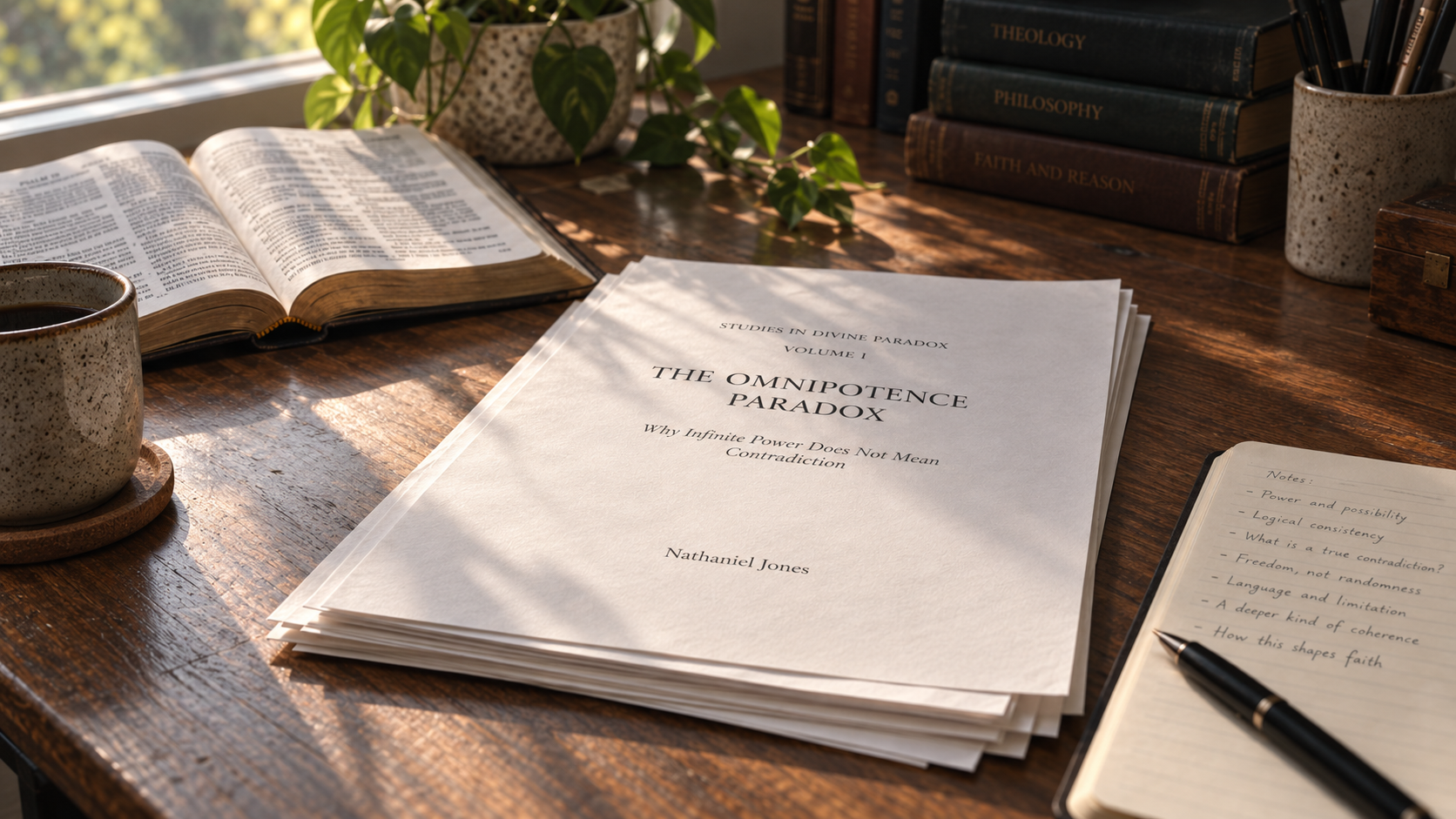
In The Omnipotence Paradox, I kept returning to one sentence:
Contradiction is not a task.1
That remains my starting point. But a starting point is not the same as a finished argument. If omnipotence excludes contradiction, we still have to ask why. Are we simply redefining God’s power to escape a difficult problem? Does logic stand above God as a rule even He must obey? And does Scripture itself support the kind of carefully qualified omnipotence philosophers have tried to define?
Those questions turn out to be harder than the stone.
What Does Scripture Mean by “All Things”?
The Bible speaks about divine power in expansive terms.
When Sarah laughs at the promise of a child, the question comes: “Is anything too wonderful for the LORD?” In Job’s final response to God, he says, “I know that you can do all things,” immediately adding that no divine purpose can be thwarted. Jeremiah confesses that God made heaven and earth by great power and that “nothing is too hard” for Him. Gabriel tells Mary, “For nothing will be impossible with God.”2
Those are strong claims.
But their contexts matter.
Genesis is speaking about the apparently impossible birth of Isaac. Jeremiah is speaking about the Creator’s power and faithfulness. Luke is speaking about Elizabeth’s pregnancy and the conception of Jesus. Job’s language about God doing “all things” is paired with the claim that God’s purpose cannot be thwarted.
These passages certainly support a robust doctrine of divine power. They do not read, however, like technical attempts to answer every question in modal logic.
Mark 14:36 makes the point especially clear. Jesus prays, “Abba, Father, for you all things are possible,” and then continues: “yet not what I want but what you want.”2 Divine ability, divine will, and what actually occurs are not treated as identical.
Scripture also contains another kind of language.
Second Timothy says that even when we are faithless, God remains faithful because “he cannot deny himself.” Hebrews describes two unchangeable things “in which it is impossible that God would prove false.” Titus speaks of God “who never lies.” James says that God “cannot be tempted by evil.”3
Whatever omnipotence means biblically, it does not seem to mean that God’s greatness requires the capacity to cease being faithful, truthful, or good.
That does not give us a complete philosophical definition of omnipotence. Scripture is not a textbook in modal metaphysics. But the evidence does make one point difficult to avoid:
Biblical power is inseparable from who God is.
The Bible does not present God as an unlimited reservoir of arbitrary capacity, as though power were detached from truth, goodness, faithfulness, and purpose.
Not Every “Can” Describes Greater Power
Anselm saw the problem centuries before the modern stone paradox became popular.
In chapter 7 of the Proslogion, he asks how God can be omnipotent if God cannot lie, be corrupted, or make what has happened not to have happened. His answer is striking: the capacity for corruption and falsehood is not greater power. It is a form of impotence. A being vulnerable to corruption is, in that respect, subject to something that can overcome it.4
That distinction deserves attention because ordinary language can mislead us.
A human being can forget.
God cannot, if God is omniscient.
A human being can become morally corrupt.
God cannot, if God is necessarily good.
A human being can die.
God cannot, if God exists necessarily.
It does not automatically follow that the human being therefore possesses three powers God lacks.
Some abilities are capacities only because the creature possessing them is vulnerable to failure.
Thomas Aquinas develops the argument differently. In Summa Theologiae I, question 25, article 3, he asks directly what Christians mean when they say God can do “all things.” His answer is not that God can do anything that can be arranged into a grammatical sentence. Rather, divine power extends to what is absolutely possible.
A contradiction does not qualify.
For Aquinas, a description involving being and nonbeing in the same respect does not identify something sitting just beyond the range of divine strength. It lacks the character of a feasible or possible thing. He therefore says it is better to say that such things cannot be done than simply to say God cannot do them.5
That is more than wordplay.
Consider the difference:
A person cannot lift a mountain because the person lacks sufficient strength.
A person cannot draw a square circle because there is no square circle to draw.
The word cannot appears in both sentences, but it is doing different work.
The first identifies a limitation in the agent.
The second identifies a failure in the proposed object.
That is the distinction at the center of the omnipotence problem.
Contradiction Is Not a Task
A difficult task remains a task.
A larger stone may require greater strength. A more complicated equation may require greater intelligence. An engineering problem may require better tools. In each case, the proposed accomplishment remains coherent even when a particular agent cannot achieve it.
Contradiction works differently.
A square circle is not an extraordinarily complicated shape.
A truth that is false in the same respect at the same time is not an unusually difficult truth.
An omnipotent being that is simultaneously overpowered by the same created object, in the same respect, is not merely facing an unusually difficult challenge.
The terms are colliding.
This is why I argued in The Omnipotence Paradox that power does not become greater by becoming incoherent.6
That claim should not be protected merely because it is mine. It should survive only if the argument survives.
I think it does.
If someone says that God is unable to move a particular object because the object’s force exceeds God’s, that would describe a genuine limitation of power.
But “make omnipotence be non-omnipotent while remaining omnipotent” does not describe a stronger achievement that God somehow fails to reach. It asks the concept to negate itself while remaining intact.
No amount of added strength changes that.
The issue is no longer force.
It is meaning.
The Strongest Objection: Is Logic Above God?
There is an obvious response.
Fine. Suppose contradictions are logically impossible.
Why should God care?
If God cannot violate logic, has the problem really disappeared? Or have we merely moved the limit from the stone to logic itself?
This objection matters because a careless answer creates an uncomfortable picture: God wants to make a contradiction true, but an eternal law called Logic stands over Him and says no.
If that were the situation, it would be fair to ask whether God is truly ultimate.
René Descartes pushed against precisely this kind of limitation. In his correspondence concerning the “eternal truths,” he argued that mathematical and logical truths depend on God rather than existing independently above Him. In a 1644 letter to Denis Mesland, he went so far as to say that God was not determined to make contradictories incapable of being true together. In 1648, writing to Antoine Arnauld, he refused to declare that God could not make one and two fail to equal three.7
Descartes gives us a serious alternative to Aquinas.
But his position also reveals the cost of admitting contradiction into divine power.
If contradiction itself can be made true, then the logical structure of the objection begins to disappear. Harry Frankfurt noticed this in his response to George Mavrodes. If an omnipotent God can perform the contradictory act of creating a stone He cannot lift, why could that same God not perform the further contradictory act of lifting the stone He cannot lift?8
Once contradiction becomes an acceptable achievement, the stone stops functioning as a trap.
God can make it.
God cannot lift it.
God lifts it anyway.
That does not feel like a solution because it is not one in the normal sense. The logical distinction that made the paradox troublesome has been surrendered.
Worse, the damage would extend well beyond stones.
If contradiction can reach into the meaning of divine attributes, then “God is faithful” no longer excludes faithlessness. “God is good” no longer excludes evil. “God exists” need not exclude God’s nonexistence in the same respect.
Theology does not become more mysterious at that point.
Language stops holding together.
Does Logic Reflect God’s Nature?
There are several possible ways to understand the relationship.
Perhaps logical truths exist independently of God.
Perhaps God freely created them.
Perhaps they somehow arise necessarily from the structure of reality.
Or perhaps logical coherence reflects God’s own necessary nature.
The last view is the one I find most persuasive.
On this account, logic is not a cosmic regulation imposed upon God. Neither is it an arbitrary rulebook God invented and could discard tomorrow. God’s inability to contradict Himself would instead belong with His inability to cease being who He is.
This is where I need to distinguish argument from conviction.
The argument against contradiction as a task does not, by itself, prove that logical necessity is grounded in God’s nature. It shows that contradictory descriptions do not function like ordinary limitations of ability. The further claim—that coherent reality ultimately reflects the coherent nature of God—is theological and metaphysical territory where more argument is required.
I believe it.
I do not think this Study proves it.
That distinction matters.
The Stone Does Not Finish the Problem
George Mavrodes famously applied the classical distinction directly to the stone paradox in 1963. If God is omnipotent, he argued, then “a stone too heavy for an omnipotent being to lift” becomes self-contradictory. The failure to produce such an object therefore does not establish deficient power. Mavrodes was careful about his conclusion: his argument did not prove that God is omnipotent. It aimed only to show that this particular alleged disproof fails.9
C. Wade Savage later argued that the paradox could be formulated more strongly without simply assuming God’s omnipotence at the beginning.10
That debate is useful because it prevents an easy victory.
Even if the familiar stone riddle fails, the philosophical work is not finished.
Contemporary discussions of omnipotence have become considerably more technical. The current Stanford Encyclopedia of Philosophy treats omnipotence in terms of maximal power, while also noting that maximal power cannot simply mean the capacity to cause every describable state of affairs. Questions about the past, the free actions of other agents, essential properties, and what an agent can cause at a particular time complicate the definition.11
Kenneth Pearce and Alexander Pruss, for example, have proposed understanding omnipotence through perfect freedom of will and perfect efficacy of will. Graham Oppy has challenged influential attempts to define omnipotence as maximal power. Wes Morriston has pressed the further question of whether necessary moral perfection itself limits the amount of power a being possesses.12
There is no need to settle all of those debates here.
But they give us an important warning:
“God can do everything logically possible” may be a useful first correction, but it is not a complete philosophical theory of omnipotence.
That is one place where my own thinking has become more qualified.
“Contradiction is not a task” still seems right to me.
It simply does not answer every question that follows.
What the Argument Establishes—and What It Does Not
The evidence
Scripture describes God’s power expansively while also describing some things as incompatible with God’s identity and character.
Anselm and Aquinas both provide historically important accounts in which some apparent incapacities do not represent weakness.
Modern philosophy confirms that naive definitions of omnipotence create serious problems, even among philosophers who disagree about the solution.
The argument
A logically contradictory description is importantly different from a difficult but coherent task.
Failure to produce a contradiction therefore does not straightforwardly demonstrate insufficient power.
The familiar omnipotence paradox cannot simply assume that every arrangement of meaningful words describes a meaningful object of power.
What remains unresolved
This argument does not tell us exactly what logical necessity is.
It does not prove that logic is grounded in God’s nature.
It does not provide a universally accepted formal definition of omnipotence.
And it does not settle every dispute about the relationship between divine power, freedom, and necessary goodness.
Those questions remain open.
What I Believe
I believe omnipotence does not include contradiction.
Not because logic is a stronger god standing over God.
Not because divine power reaches an invisible boundary and fails.
And not because difficult questions should be dismissed as nonsense whenever they become uncomfortable.
I believe contradiction is excluded because contradiction does not name a greater exercise of power.
A perfectly truthful God is not diminished because He cannot be false while remaining perfectly truthful. A perfectly good God is not diminished because He cannot become evil while remaining perfectly good. And an omnipotent God is not diminished because He cannot be overpowered while remaining omnipotent in the same respect.
As I wrote in The Omnipotence Paradox:
God is not less because He cannot be less.13
That remains conviction, but it is conviction I think the argument can reasonably support.
There is still a mystery here. I do not pretend to know exactly how logical necessity relates to the divine nature or how finite minds should describe every aspect of infinite power.
But mystery and contradiction are not the same.
Mystery may tell us that our understanding is incomplete.
Contradiction tells us that our terms have stopped holding together.
Confusing those categories does no service to faith or reason.
Conclusion
So, does omnipotence include contradiction?
I do not think it does.
The strongest reason is not that God faces a category of tasks called logical impossibilities and lacks enough power to complete them. It is that contradiction does not operate like a task in the first place.
That conclusion is narrower than saying every philosophical question about omnipotence has been solved.
It has not.
We still have to ask what maximal power means. We still have to ask how God’s necessary goodness relates to divine freedom. And we still have to ask the deeper metaphysical question of why logical necessity has the structure it does.
Those are real questions.
The stone remains useful because it forces us to ask them.
But the longer I examine the paradox, the less the stone itself seems to matter. Weight was always the image. Meaning was the problem.
The real weight was in the words.
Notes
- Nathaniel Jones, The Omnipotence Paradox: Why Infinite Power Does Not Mean Contradiction (2026), 44. ↩1
- Genesis 18:14; Job 42:2; Jeremiah 32:17; Luke 1:37; Mark 14:36, NRSVue. ↩1 ↩2
- 2 Timothy 2:13; Hebrews 6:18; Titus 1:2; James 1:13, NRSVue. ↩1
- Anselm, Proslogion 7. ↩1
- Thomas Aquinas, Summa Theologiae I, q. 25, a. 3. ↩1
- Jones, The Omnipotence Paradox, 55. ↩1
- René Descartes, The Philosophical Writings of Descartes, vol. 3, The Correspondence, ed. and trans. John Cottingham, Robert Stoothoff, Dugald Murdoch, and Anthony Kenny (Cambridge University Press, 1991), 25, 235, 358–59. Descartes’s precise position on the modal status of the eternal truths remains disputed, so these passages should not be reduced to the simple claim that “Descartes believed contradictions are possible.” ↩1
- Harry G. Frankfurt, “The Logic of Omnipotence,” The Philosophical Review 73, no. 2 (1964): 262–263. ↩1
- George I. Mavrodes, “Some Puzzles Concerning Omnipotence,” The Philosophical Review 72, no. 2 (1963): 221–223. ↩1
- C. Wade Savage, “The Paradox of the Stone,” The Philosophical Review 76, no. 1 (1967): 74–79. ↩1
- Stanford Encyclopedia of Philosophy, “Omnipotence,” substantive revision May 21, 2026. ↩1
- Kenneth L. Pearce and Alexander R. Pruss, “Understanding Omnipotence,” Religious Studies 48, no. 3 (2012): 403–414; Graham Oppy, “Omnipotence,” Philosophy and Phenomenological Research 71, no. 1 (2005): 58–84; Wes Morriston, “Omnipotence and Necessary Moral Perfection: Are They Compatible?,” Religious Studies 37, no. 2 (2001): 143–160. ↩1
- Jones, The Omnipotence Paradox, 109. ↩1
Further Reading
- Anselm, Proslogion, chapter 7. Thomas Aquinas, Summa Theologiae I, question 25. George I. Mavrodes, “Some Puzzles Concerning Omnipotence.” Harry G. Frankfurt, “The Logic of Omnipotence.” C. Wade Savage, “The Paradox of the Stone.” Stanford Encyclopedia of Philosophy, “Omnipotence.” Nathaniel Jones, The Omnipotence Paradox: Why Infinite Power Does Not Mean Contradiction.